
Telling you with NO REGRETS about Elie Wiesel’s “Night”…..
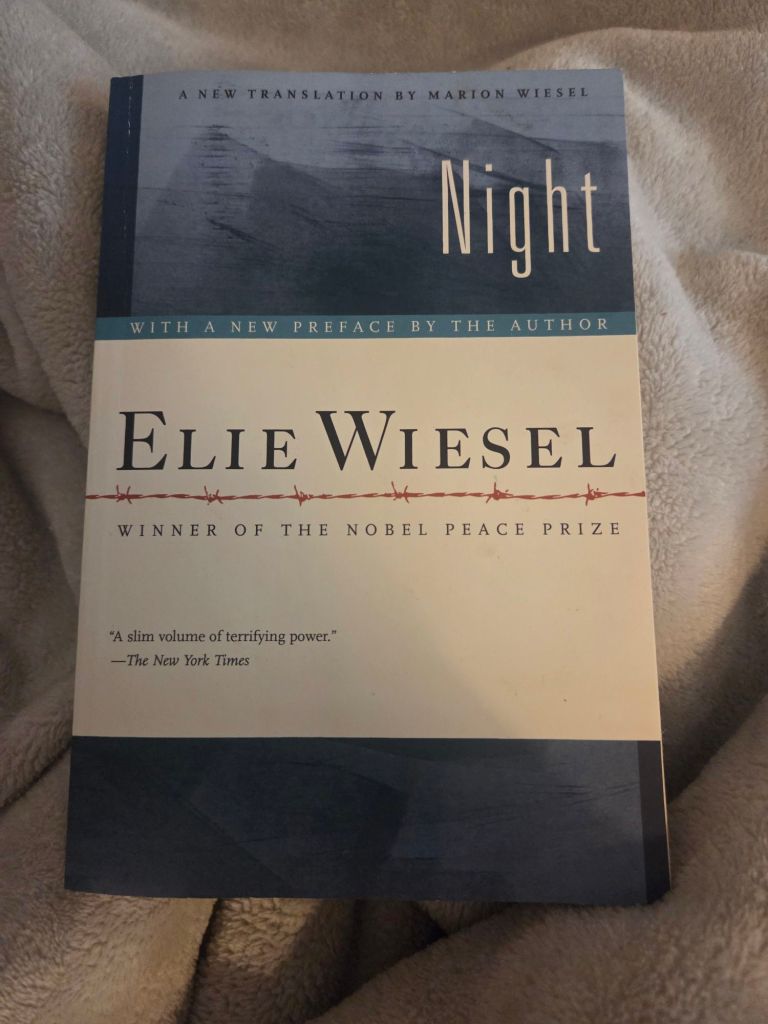
My last read was Elie Wiesel’s Night, and I do not know that I have ever held such a small book that carried such a terrible weight. It is unassuming in the hand, barely more than a breath of pages, yet inside it lives a darkness that does not remain on the page. It enters the room with you. It sits beside you. It asks you to look, and then it refuses to let you look away.
I found Night on a banned-book table at Books-A-Million, and I could not resist picking it up. Maybe because I have loved history all my life. Maybe because I am old enough to remember when history was not treated as an inconvenience, when truth was something we studied, wrestled with, and passed down. Maybe because I still hear in my mind, the stories of my grandfathers, great-aunts, and great-uncles who lived through World War II and carried its memories forward. I consider that a blessing. I consider it a gift to have known people who understood, firsthand, that history is not an abstract thing. It is blood, hunger, fear, courage, grief, and survival.
There are people now who deny, diminish, mock, or soften the Holocaust into something less than what it was. But yes, it was real. Auschwitz was real. The cattle cars were real. The ghettos were real. The camps were real. The smoke, the starvation, the selections, the cold, the cruelty, the deliberate machinery of human destruction… all of it was real. Elie Wiesel, who survived Auschwitz and Buchenwald as a teenager, spent his life bearing witness so the world would remember what happened and what human beings are capable of doing to one another.
I thought this would be my “read at work” book, something I could carry with me and open between the ordinary demands of the day. I was wrong. After the preface to the new translation, I knew I had to read it at home. I needed quiet. I needed space. The emotion of it, the bare reality of Wiesel’s words, was too heavy to carry casually. The horror did not shout. That may be why it struck so deeply. It simply told the truth.
Again and again, I had to stop reading. I had to close the book, breathe, and absorb the reality of what this Jewish boy saw, endured, lost, and survived. There are sentences in Night that feel carved out of ash. There are moments so plain in their telling, that the mind almost rejects them, not because they are doubtful, but because they are unbearable. That is the power of witness. It does not decorate suffering. It does not need to. It stands before you and says… THIS HAPPENED.
And that is why books like this matter. Not because they are comfortable. Not because they are easy. Not because they allow us to feel safely removed from the past. They matter because they disturb us in the most necessary way. They remind us that evil is not a myth or a monster from some distant story. Evil is a human possibility. It rises when hatred is fed, when racism is excused, when fascism is made respectable, when ordinary people look away, and when truth is treated as optional.
In this chaotic world, with hatred and racism growing louder and democracy feeling more fragile than it ought to feel, Night did not read like a relic. It read like a warning. It reminded me of Hitler, of fascism, of what happens when a society allows fear and cruelty to become policy. It reminded me that history does not stay safely behind us unless we keep telling the truth about it.
I know why some people would want this book banned. It refuses comfort. It refuses denial. It refuses to let ignorance have the last word. But that is exactly why it must be read. If you have questions, read it. If you wonder how such things happened, read it. If you doubt what hatred can become when given power, read it. If you believe history no longer has anything urgent to teach us, read it twice.
Night is not simply a book about the final days before the end of the war and Hitler’s defeat. It is a testimony from within the dark. It is a remembrance of the dead and a charge to the living. It asks us to bear witness, to resist indifference, and to guard the truth with something stronger than nostalgia. We owe that much to those who suffered. We owe that much to those who survived. And we owe it to the future, because forgetting is never innocent.


Leave a Reply